

5 - On the Record
How a House of Lords submission became the starting point for a new investigation

This is the fifth post in a series examining whether the forensic science system in England and Wales responds consistently when things go wrong, or whether the response depends on who the provider is. The previous post examined the governance structure of Hampshire Scientific Services.
While I was investigating the governance structure of Hampshire Scientific Services, asking questions about who was legally responsible for the activities on its UKAS schedule, HSS was on the brink of losing its accreditation for Detection and quantitation of drugs in relation to s5A of the Road Traffic Act 1988.
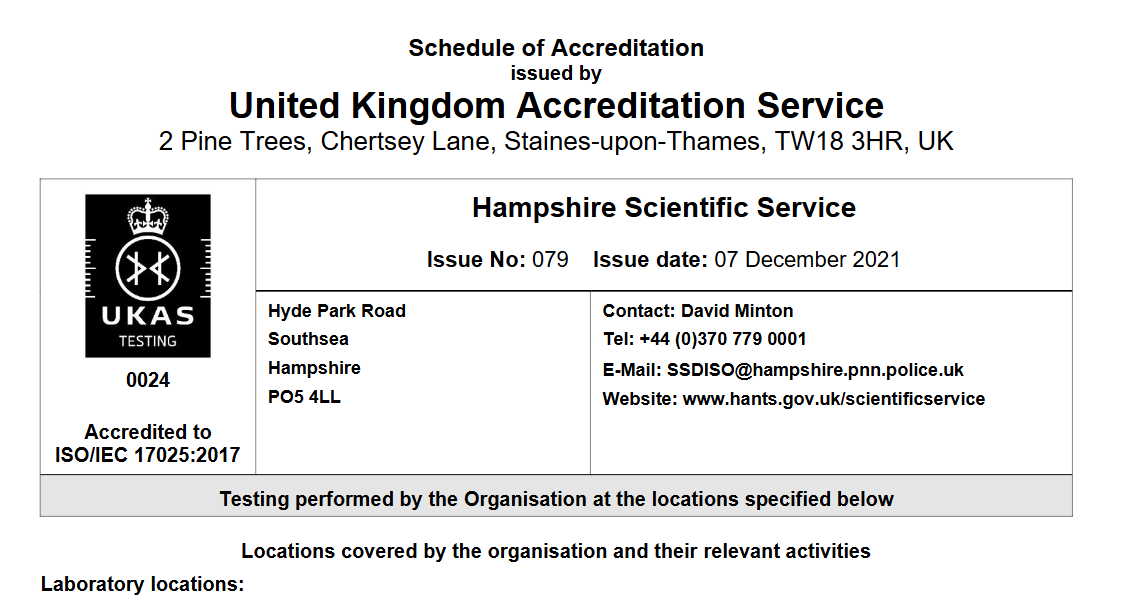
I did not know that at the time. I found out later, by comparing archived versions of the UKAS schedule. The December 2021 schedule clearly showed S5A on page 161. By March 2023, it was gone2. It has since been reinstated3. Those are facts I can verify from documents in the public domain.
What I could not verify, from the public domain, was anything else. When Randox failed, there was a 7 year criminal investigation and much has been said about the causes of that by the Forensic Regulator and others in period since. When Synlab failed, the Forensic Regulator published a lessons learnt review. For Hampshire Scientific Services, there was nothing. No report from the Forensic Regulator. No public statement. No information in the public domain at all. Just a change on a UKAS schedule that only some weirdo comparing archived versions would notice.
Why was it removed? Were cases affected? Were defendants or their legal representatives informed? Was the Forensic Regulator notified?
After Randox, after Synlab, the loss of S5A accreditation at any laboratory providing toxicology results to criminal courts should be a matter of serious public concern. It is worth noting that the Forensic Regulator’s office was actively investigating the Synlab’s S5A failures throughout the same period that HSS lost its S5A accreditation. I’ve no doubt that the Forensic Regulator must have been particularly alert to the risks within forensic toxicology across the criminal justice system at that precise moment.
This series has examined how the system responds when private providers fail. Whether it responds with the same rigour when a public sector provider fails is the question this investigation attempted to answer.
On 8 January 2026, I submitted written evidence to the House of Lords Science and Technology Committee inquiry into forensic science.4
I put on the record, specifically, my concerns about Hampshire Scientific Services. The loss of S5A from the UKAS schedule. The unanswered questions. The silence from UKAS and the Forensic Regulator when I had raised the structural governance concerns in March 2022. The changes in UKAS schedules since.
Submitting evidence to a parliamentary committee is one thing. Getting answers to specific questions about what actually happened is another.
So on 30 January 2026, I submitted Freedom of Information requests to three separate public authorities, each of whom holds a different piece of the picture.
The approach was deliberate. HSS sits between two organisations, Hampshire County Council and Hampshire Constabulary, under a governance structure that, as I described in the previous post, makes it genuinely unclear who is responsible for what. The CPS, as the prosecuting authority, holds a different piece. Whilst it may hold records about why accreditation was lost, more importantly what the CPS holds are the records of impact. Prosecutions affected, cases reviewed, evidence disclosed or withdrawn, and any failures that followed from relying on results from a laboratory that had lost its accreditation. Each of these three bodies has obligations, and between them they should hold the full picture of what happened and the impact it had, if any, on the criminal justice system.
Three requests. Same subject. Same time period, 1 January 2021 to 31 December 2025. Different questions tailored to each body’s role.
To Hampshire Constabulary, I asked for correspondence between the Constabulary and HSS, UKAS, and the Forensic Regulator concerning S5A accreditation. I asked for operational impact documents: risk assessments, decision logs, continuity plans describing how S5A cases were handled during the period of lost scope. And I asked for anything concerning criminal justice impact and disclosure, including communications with CPS about whether cases needed to be reviewed, whether defence teams were informed, whether results could be relied upon.
To Hampshire County Council, the host organisation for HSS under the MOU, I asked for UKAS assessment reports, surveillance reports, notices of suspension or withdrawal, nonconformities, and any correspondence explaining the basis for S5A removal or reinstatement. I asked for internal quality documentation: root cause analyses, corrective action plans, management review minutes, risk registers. I asked for communications with the Forensic Regulator about S5A compliance concerns.
To the Crown Prosecution Service, I asked for correspondence with Hampshire Constabulary, Hampshire County Council, and the Forensic Regulator concerning HSS S5A accreditation. I asked for any guidance, memos, or decision logs about how prosecutors should handle HSS evidence during the period of lost scope, including whether cases required review or disclosure. I asked how many cases, if any, resulted in failed prosecutions as a consequence. I asked for any records of CPS involvement in governance or assurance discussions about HSS toxicology services.
If the system worked as it should, all three bodies would hold records showing that the loss of S5A accreditation was identified, communicated, managed, and its impact on live and historic cases properly assessed. The records should be consistent. The timelines should align. All relevant disclosure obligations should have been met.
If the system did not work as it should, any gaps will tell that story too.
Hampshire Constabulary responded on 26 February 2026. The CPS responded on 27 February 2026. Hampshire County Council have yet to respond.
I now have two sets of documents from two of the three bodies. The Council’s response, when it arrives, will complete the picture, or at least as much of it as FOI can reveal.
The next post will examine what Hampshire Constabulary disclosed.