

6 - Planned
What Hampshire Constabulary said, and what their own documents show

This is the sixth post in a series examining whether the forensic science system in England and Wales responds consistently when things go wrong, or whether the response depends on who the provider is. The previous post described why I submitted written evidence to the House of Lords and the FOI requests that followed.
Hampshire Constabulary responded to my Freedom of Information request on 26 February 2026, within the statutory time limit. I am grateful for that. What follows is an examination of what they said, and what the documents they attached reveal.
The full FOI response can be found here. Some of the attachments are difficult to read, the font is tiny. This is precisely how they were provided to me.
The cover letter made two statements.
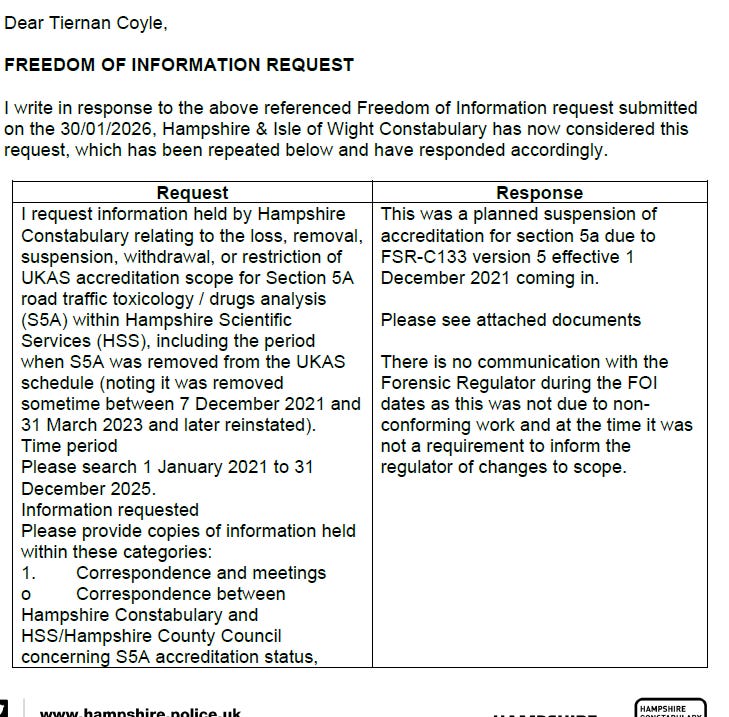
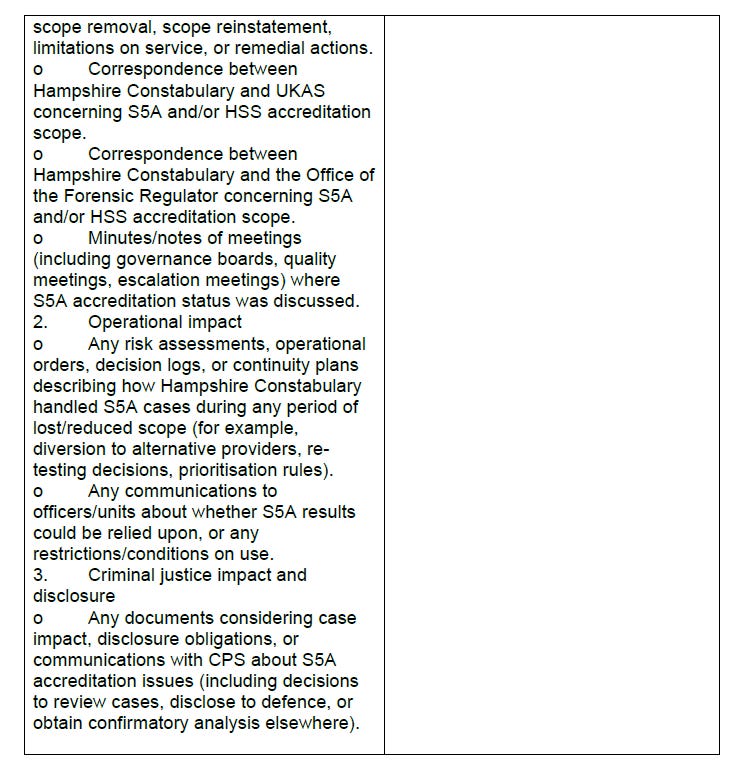
1. A planned suspension
The loss of S5A accreditation was “a planned suspension of accreditation for section 5a due to FSR-C133 version 5 effective 1 December 2021 coming in.”
2. Not due to non-conforming work, and no communication with the Forensic Regulator
The Constabulary stated that there was “no communication with the Forensic Regulator during the FOI dates as this was not due to non-conforming work and at the time it was not a requirement to inform the regulator of changes to scope.”
The FOI dates I specified were 1 January 2021 to 31 December 2025. Five years. A UKAS letter dated 29 August 2024 confirms that S5A accreditation was reinstated on that date. At no point during that period, according to Hampshire Constabulary, was there any communication with the Forensic Regulator about it.
No notification of the suspension. No notification of the withdrawal. No communication during the years it took to reinstate the service. No communication when they got their accreditation back. Nothing.
The Constabulary’s position is that there was no obligation at the time to inform the Regulator of changes to scope. But the obligations that existed at the time tell a different story.
Throughout the period when HSS held and then lost its S5A accreditation, the Forensic Science Regulator’s non-statutory Codes of Practice were in force. Section 14.1.2 of those Codes required forensic units to inform the Regulator at the earliest opportunity about any complaint or non-conforming work if it “could attract adverse public comment, be against the public interest or lead to a miscarriage of justice.”
Beneath all of this sits an obligation that does not depend on any Code, statutory or otherwise. The Criminal Procedure and Investigations Act 1996 requires the prosecution to disclose material that might reasonably be considered capable of undermining the prosecution case or assisting the defence. That is a continuing duty. The accreditation status of the laboratory that produced the evidence is material the defence is entitled to know about.
This was not a routine administrative change to a UKAS schedule. This was the loss of a forensic capability that directly affects criminal prosecutions. It happened during a period when the Forensic Regulator’s office was actively investigating S5A failures at Synlab, another laboratory that had provided exactly the same type of analysis.
What the attachments say
The cover letter described a planned suspension. The documents attached to the same FOI response describe something more complicated.
The key documents in the disclosure appear to be an email from HSS to Hampshire Constabulary setting out the current position on S5A analysis and an action plan. An email chain between UKAS and Hampshire police concerning the suspension of seven specific drugs. A summary email shared internally with HSS staff in December 2024, compiling the history into a single thread.
I will take them in the order the events occurred.
The HSS email: what was actually happening inside the laboratory
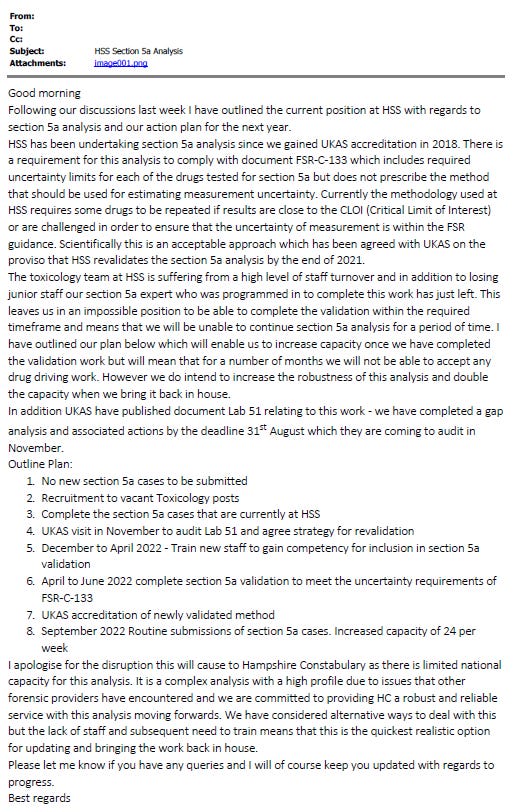
The first document is an email from persons unknown, however it appears likely to be from HSS to Hampshire Constabulary. It is undated in the copy provided, but its content places it in 2021, before the suspension took effect.
It states that HSS had been undertaking S5A analysis since gaining UKAS accreditation in 2018. It explains that the methodology used at HSS for estimating measurement uncertainty required some drugs to be repeated if results were close to the Critical Limit of Interest. UKAS had agreed this approach was scientifically acceptable, on one condition: that HSS revalidated its S5A analysis by the end of 2021.
The email then describes what happened. The toxicology team was suffering from a high level of staff turnover. Junior staff had been lost. The S5A expert who had been programmed to complete the revalidation work had just left. The email is candid about the consequence:
“This leaves us in an impossible position to be able to complete the validation within the required timeframe and means that we will be unable to continue section 5a analysis for a period of time.”
The email set out an outline plan. No new S5A cases to be submitted. Recruit to vacant posts. Train new staff from December 2021 to April 2022. Complete the revalidation from April to June 2022. Seek UKAS accreditation of the newly validated method. Return to routine S5A submissions by September 2022.
The email closed with an acknowledgement that the disruption would affect Hampshire Constabulary, and that there was “limited national capacity for this analysis.” It noted that S5A work was “a complex analysis with a high profile due to issues that other forensic providers have encountered.”
The UKAS recommendation: compulsory suspension
Following a UKAS Lab 51 audit visit on 23 November 2021, UKAS found HSS not compliant. The compulsory suspension recommendation was discussed with HSS at the visit in November. On 21 December 2021, UKAS formally submitted the recommendation: seven specific drugs to be suspended from the HSS schedule. Benzoylecgonine, Diazepam, Flunitrazepam, Ketamine, Morphine, Oxazepam and Temazepam. The suspension was to take effect from 24 December 2021. HSS was permitted to complete the remaining 48 samples already in the system before that date.

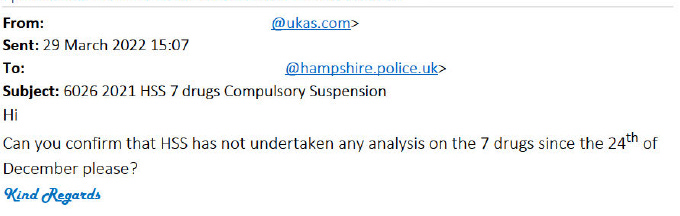
The subject line of the email chain through which this was communicated reads: “6026 2021 HSS 7 drugs Compulsory Suspension.”
The voluntary withdrawal: all S5A, not just seven drugs
On 29 March 2022, UKAS emailed Hampshire police to confirm that HSS had not undertaken any S5A analysis on the seven suspended drugs since 24 December 2021. The email was forwarded internally within Hampshire police. The response confirmed that no S5A testing had been carried out for any drugs since that date. It stated that with the imminent purchase of two new LC-MS/MS instruments, HSS had made “the business decision to withdraw our accreditation for all section 5a work.” The plan, according to the email, was to install the new instruments and then validate an agreed suite of S5A drugs on the new equipment.
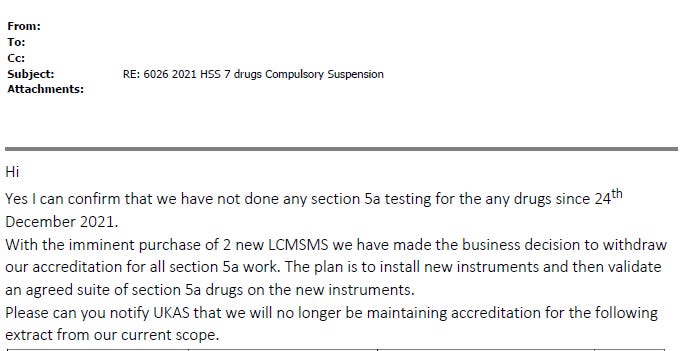
So there were two events, not one. In December 2021, UKAS compulsorily suspended seven drugs. In April 2022, HSS voluntarily withdrew all remaining S5A accreditation. The cover letter to the FOI response described the entire episode as “a planned suspension.” That description does not distinguish between a compulsory suspension imposed by UKAS and a voluntary withdrawal requested by HSS four months later. It treats them as a single event. They were not.
Timeline
23 November 2021 — UKAS conducts Lab 51 audit visit at HSS. Finds HSS not compliant. The compulsory suspension recommendation is discussed with HSS at the visit.
21 December 2021 — UKAS formally submits the recommendation, based on the report discussed at the November visit. Seven drugs to be suspended from 24 December, allowing HSS to complete the remaining 48 samples in the system.
24 December 2021 — Compulsory suspension takes effect. No S5A testing from this date.
29 March 2022 — UKAS contacts Hampshire police to confirm no testing since 24 December. HSS confirms, and requests voluntary withdrawal of all remaining S5A accreditation.
24 April 2022 — UKAS assessor records the voluntary withdrawal of all S5A accreditation.
2 October 2023 — Statutory Code of Practice comes into force. Section 37.3.1 requires prompt notification to the Regulator of any change in accreditation status. HSS still without S5A accreditation.
29 August 2024 — UKAS grants extension to scope. S5A accreditation reinstated. Two years and eight months after the original suspension.
January 2021 to December 2025 — According to Hampshire Constabulary, no communication with the Forensic Regulator at any point during this period.
Questions
UKAS visited HSS on 23 November 2021, found the laboratory was not compliant, and discussed the compulsory suspension recommendation with HSS at the visit. The formal recommendation was submitted on 21 December 2021, to take effect from 24 December. HSS was permitted to complete the remaining 48 samples before that date. HSS knew from November that compulsory suspension was coming, yet continued to produce S5A results for criminal cases for another month. Why was HSS permitted to continue producing results for a month after UKAS found it was not compliant?
The S5A expert who was programmed to complete the revalidation left. The toxicology team was suffering from a high level of staff turnover. Was this loss of capability reported to anyone outside of HSS and Hampshire Constabulary? Was the Forensic Regulator informed that a laboratory providing S5A results to the criminal courts had lost the only expert capable of completing the work required to maintain its accreditation at a point of deep crisis within the supply of services nationally in forensic toxicology?
Were any criminal cases affected by the loss of S5A accreditation? Were any prosecutions dropped, reviewed, or referred for re-analysis? Were defendants or their legal representatives informed that the laboratory which had produced the toxicology evidence in their case had lost its accreditation for that work? Were disclosure obligations met?
They are questions that the documents provided by Hampshire Constabulary raise but do not answer.
What was not provided
The Constabulary’s response was incomplete. My original request contained three numbered categories. The response addresses only part of the first.
Category 1 asked for correspondence and meeting records. Some correspondence was provided. But I also asked for minutes or notes of meetings, including governance boards, quality meetings, and escalation meetings, where S5A accreditation status was discussed. Nothing was provided in that category. No statement was made about whether such records exist. Given that S5A testing was unavailable for an extended period affecting active criminal cases, it would be surprising if this was never discussed in any governance or quality forum within the Constabulary.
Category 2 asked for operational impact documents: risk assessments, operational orders, decision logs, continuity plans, and any communications to officers or units about how S5A cases were handled during the period of lost scope. The response is entirely silent on this category. No documents. No confirmation or denial of whether such information is held. No exemption cited.
Category 3 asked for criminal justice impact and disclosure documents: anything considering case impact, disclosure obligations, or communications with CPS about S5A accreditation issues. Again, the response is entirely silent. No documents. No confirm or deny. No exemption.
Under the Freedom of Information Act, the Constabulary is required to confirm or deny whether it holds information within the scope of each part of a request. If information is held, it must be communicated unless an exemption applies. If the Constabulary wishes to withhold information, it must issue a refusal notice specifying the exemption relied upon. The response does none of these things for Categories 2 and 3, or for the meeting records in Category 1.
I have requested an internal review.
The next post will examine what the Crown Prosecution Service disclosed in response to the same line of inquiry. The response from Hampshire County Council, when it arrives, may answer some of the questions that sit on their side of this arrangement.